CNMI Marine monitoring program
Benefit of Long-Term Monitoring
The goal of CNMI’s long-term coral reef monitoring program is to provide the information necessary for the wise management of our precious reef resources. We document how reef communities change over time in response to natural fluctuations, acute disturbances (e.g. typhoons), and chronic disturbances (e.g. NPS pollution). Following changes over time allow us to assess the impacts of land-based pollution and if management actions are needed, or working.
In addition, monitoring teaches us what types of organisms live on CNMI’s reefs and where they live. This tells us what areas are most precious and endangered so we can prioritize our limited management funding and resources to these regions.
Proactive Species Conservation to Include Guam
CRM has been awarded a second year of funding from NMFS Office of Protected Resources to assess the status of Atuhong and Tanguisson in CNMI and Guam. Ecological surveys and interviews with fishermen will be conducted around Guam. A sonic tagging study on Saipan will help define home range sizes for Tanguisson. Learn more on our PSCG Webpage.
Flinders University Underwater Archaeology Training
MMT members from Coastal Resources Management learned the basics of surveying submerged wrecks this past July. This training reflects the recent addition of the Historic Preservation Office to the CNMI Scientific Diving Program and builds the team’s skills to manage vessel grounding events. Jen McKinnon and Jason Raup led the training and will be returning next year to develop an underwater historical trail on Saipan.
7 Aug 09
Personnel Changes
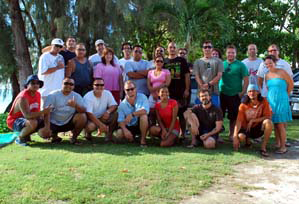
John Iguel, long-time MMT member, has transfered to DEQ the Technical Branch and will now support the MMT full-time.
Rodney Camacho and David Benavente have been hired by CRM as full-time Marine Technicians under the Coral Reef Section. Both are former interns with the Coral Reef Initiative program and are recent college graduates. Their full-time addition to the team is a major boost in the program’s capability to assess and monitor our marine environment.
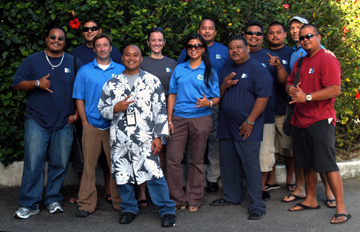
Dr. Peter Houk, a nine year veteran of the MMT is leaving DEQ. He largely responsible for the current form and direction of the current MMT program. He is taking a job as the executive director of the Pacific Marine Resources Institute on Saipan.
Species of Concern: Atuhong & Tanguisson
CRM has recieved a “Proactive Species Conservation Grant” through NOAA’s Office of Protected Resouces to study the distribution of Chelinus undulatus (Tanguisson) and Bolbometopon muricatum (Atuhong) around Saipan, Tinian, Rota and Agijuan. We hope the information collected will help build our understanding of population numbers and habitat use needed for development of management plans for both species. Learn more: PSCG Webpage
2008 CNMI Marine Monitoring Plan Released
The Coastal Resources Management Office and Division of Environmental Quality have jointly approved a revised monitoring plan that covers both activities of the MMT and DEQ’s Environmental Surveillance Laboratory. The plan is revised approximately every five years and provides an overview of marine and water quaility survey activities in the CNMI, documents methods being used, and provides guidance on the programs plans for expanding monitoring activities in coming years. Click the Data Reporting link at the top right of this page to access a downloadable 10MB pdf of the report.
CNMI’s Interagency Marine Monitoring Team celebrates 10 years of marine research.
Formed at the behest of DEQ in 1997 to address concerns over sediment erosion from an illegal land clearing in Lau Lau Bay, the MMT has expanded surveys assessing and monitoring reef conditions throughout the Marianas. Actively supported by Coastal Resources Management, the MMT has had participation from Division of Fish and Wildlife, Northern Marianas College and a large number of volunteers since itt inception. An article on the MMT was featured in NOAA’s National Coastal Program News in April of this year. Click here to download a copy of the .pdf article>> MMT Article
MMT Students… still going strong
Summer intern and Northern Marianas College student Andrew Moses has stayed with our program as a work-study student. Andrew will be continuing a population study of the intertidal clam Atactodea, assisting with a collaborative project to understand heavy metal concentrations in bivalves in Saipan Lagoon.
He will be also be helping with an ongoing project to map water quality in Saipan Lagoon. The water quality project recently received support in the form of of a YSI6600 multi-parameter water quality sonde provided by the NSF-ATE program Partnership for Advanced Marine and Environmental
Science Training for Pacific Islanders through NMC’s science and mathematics department . Thanks go to both of these programs for supporting CNMI’s marine monitoring program.
Volunteer discovers urchin unkown in Mariana Islands!
The image to the left was taken by Capt. Carl Brachear while snorkelling in Saipan Lagoon. His discovery is the first certain record of the sea urchin Asthenosoma varium in the Mariana Islands! Thanks go to Capt. Carl for sharing this image and providing interesting reports about some other rare species in the lagoon. If you have seen something unusual during a dive or snorkel, feel free to contact CRM to report it: 664-8300 or consider joining the BioSearch Program described below.
BioSearch… Volunteer with the MMT!
Do you log your dives? Do you want to help manage our local marine resources? You can do both by participating in the BioSearch Program. By filling out observations about your dive or snorkel, you can help us fill in gaps about some of the larger animals found in Marianas waters- whales, sharks, turtles, and help warn of environmental changes such as the appearance of Crown of Thorns seastars and Coral Bleaching.
To find out more about this program, visit the BioSearch Homepage.